I’ve finally gotten back to working on the Concrete Tie Car project. The mold is finished (I’ll cover that in another blog entry), and I’m ready to start producing injection-molded stacks of N-scale ties. For this project, I’m going to be using my Travin TP1 injection-molding machine because it has support for activating ejector pins. I’m going to have to make about 1,000 parts, so having ejector pins makes a huge difference.
There is one little flaw in the TP1 design that has been driving me nuts. On top of the machine is a hopper that contains the plastic pellets, which are fed into the hot cylinder via a small tube. This works OK, except that some of the pellets tend to jump out of the cylinder and get all over my table:
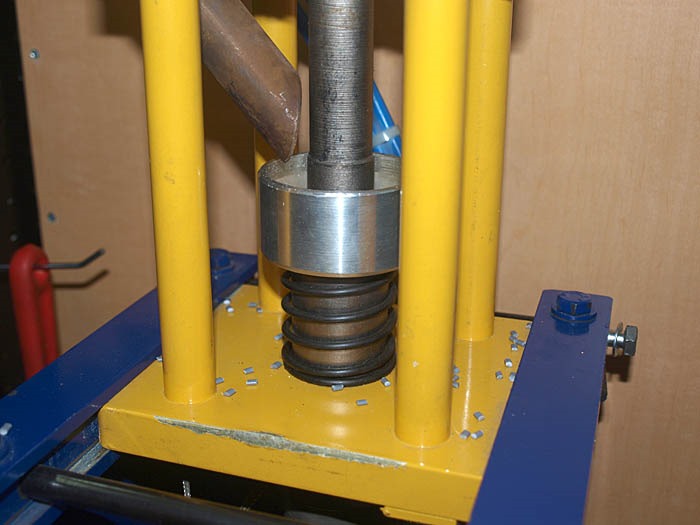
You can see the gray pellets on top of the flat yellow part. The rust-colored tube that is at an angle near the top of the photo is the pellet-delivery tube. Given it’s location and angle, it’s amazing that most of the pellets make it into the cylinder (in the center of the photo). The plunger, by the way, is the rod that goes from the top of the photo to near the center. Because I didn’t have air pressure applied, it’s sitting slightly inside the cylinder.
To fix my problem, I decided I needed a funnel to keep the pellets from jumping out. And I certainly could have made one with some cardboard. However I recently got a very nice 3D printer (a MendelMax 2.0), so I had to make a funnel on the 3D printer
I designed a funnel that I could fit in between the bars and then clamp in place. The funnel itself is split in two so I can get it between the bars and around the plunger. All together there are four parts, and here is the final result:
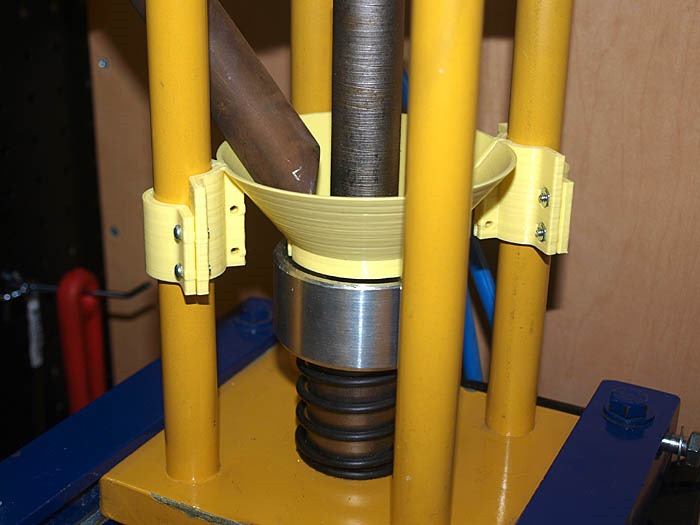
It took me about an hour to design the parts, and a couple of hours to print all the parts (which it doesn’t without me having to watch it). There are some things that aren’t quite right, but it works, so I’ll call it a job well done and move on to injection-molded parts.
This comment has been removed by the author.
ReplyDeleteThis comment has been removed by the author.
ReplyDelete